 QRJiffy
Bitcoin & Crypto QR Code Generator
A crypto QR code sends a wallet app to your receiving address, with an optional amount, so the payer never copies a 26–62 character address by hand. QRJiffy encodes Bitcoin payment URIs in the BIP21 format, which every major Bitcoin wallet reads, and the same scheme style for Ethereum, Litecoin and Dogecoin.
Just your email to download · no password needed
Phones read this code directly, so it has no scan count.
Encoded data
How to create a crypto QR code
You create a crypto QR code in 5 steps with the free generator above, and the code is ready to download as PNG or SVG.
- Open your wallet and copy a receiving address for the coin you want.
- Choose the coin that matches the address network.
- Add an amount and label if you invoice a fixed sum.
- Download the code and print the first and last 6 characters of the address beside it.
- Send a small test amount from a second wallet before you publish the code.
What does a crypto QR code contain?
A crypto QR code stores coin (URI scheme), wallet address, plus optional amount, label.
| Payload standard | BIP21 (Bitcoin), EIP-681 style (Ethereum), coin URI schemes |
|---|---|
| Native camera support | Scanned inside wallet apps; phone cameras offer to open an installed wallet |
| Needs internet to use | Yes — the payer’s wallet broadcasts the transaction |
| Editable after printing | No — a new address needs a new code |
| Scan tracking | Not available; the blockchain records every payment publicly |
| Recommended error correction | M (15%); long addresses make dense codes |
| Minimum print size | 2.5 × 2.5 cm (1 in) for a 42-character address |
| Field | Required | What it does | Example |
|---|---|---|---|
| Coin (URI scheme) | Yes | Tells the wallet which network the address belongs to. Sending on the wrong network loses funds. | bitcoin |
| Wallet address | Yes | The public receiving address. It is safe to share. | bc1qar0s…5mdq |
| Amount | Optional | Requested amount in whole coins; wallets let the payer edit it. | 0.001 |
| Label | Optional | A recipient name or purpose shown on some wallets’ send screens. | Donation |
Crypto QR code payload format
<scheme>:<address>?amount=<amount>&label=<label>
bitcoin:bc1qar0srrr7xfkvy5l643lydnw9re59gtzzwf5mdq?amount=0.001&label=Donation
Bitcoin URIs follow BIP21; the amount is in BTC, not satoshis. Ethereum payment URIs are defined by EIP-681, and wallets differ in how they read amounts, so test an Ethereum code with the wallet your payers use.
Format reference: BIP 21: URI scheme for Bitcoin payments (Bitcoin BIPs)

Is it safe to share a Bitcoin QR code?
Yes, a Bitcoin QR code contains only your public receiving address, which cannot be used to spend your coins.
Anyone can see payments to a public address on the blockchain. Use a fresh receiving address for each printed code if you want more privacy.
What happens if someone sends the wrong coin to the address?
Coins sent on the wrong network are usually lost, because the address belongs to a different blockchain.
Can a crypto QR code accept Lightning payments?
No, QRJiffy encodes on-chain addresses only; Lightning invoices are created by your Lightning wallet for each payment.
What happens when someone scans a crypto QR code?
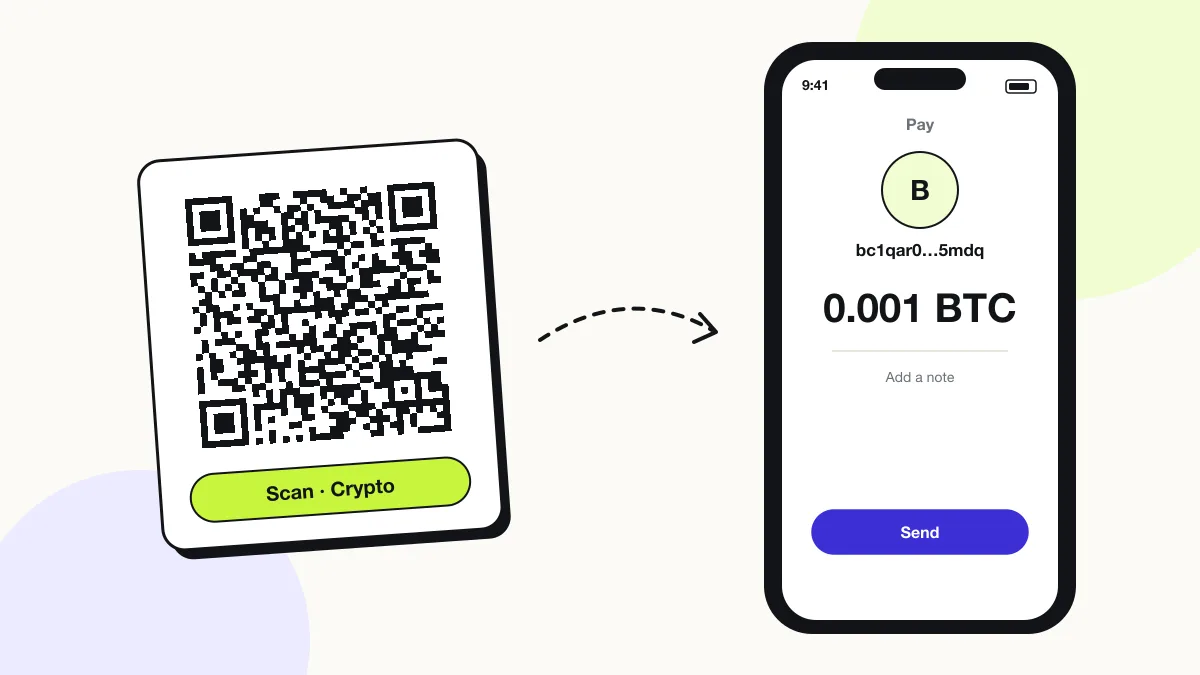
The phone camera decodes a crypto QR code in under a second and shows a prompt; tapping it starts the action stored in the code. The prompt differs by device:
Wallet apps
Wallets such as Bitcoin Core, BlueWallet, Trust Wallet and exchange apps read the URI and fill in address, amount and label.
Phone camera
Cameras recognise bitcoin: and similar schemes and offer to open an installed wallet.
No wallet installed
The phone shows the raw text; the payer copies the address into their exchange app.
Is there a scan limit on a crypto QR code?
No, a crypto QR code has no scan limit, because the phone reads the details straight from the pattern without visiting QRJiffy. That also means it works offline but cannot be edited or counted after printing; print a new code when the details change.
Where to use crypto QR codes
Crypto QR codes work in 4 common places: donations, shops, invoices and paper wallets.
Donations
Creators and nonprofits print an address code on streams and posters.
Shops
Merchants accept Bitcoin at the counter without a payment processor.
Invoices
A code with the amount speeds up B2B crypto payments.
Paper wallets
A receive-only code on a cold-storage backup card lets people top up the wallet.
Crypto QR code best practices
A crypto QR code scans first time when it follows these 4 rules.
- Never encode a private key or seed phrase; the code is for receiving only.
- Print the first and last 6 characters of the address so payers can verify it after scanning.
- Check your printed codes for tampering, the same way shops check payment stickers.
- Test each code with a small payment before you publish it.
Crypto QR code FAQ
Can I reuse the same crypto QR code for every payment?
Yes, though many wallets generate a fresh address per payment for privacy. A reused address links all your payments on the public chain.
Can I put an amount in an Ethereum QR code?
Yes, but wallet support varies. Some wallets read the amount; others open the address only. Test with your payers’ wallets.
Which wallets read BIP21 Bitcoin codes?
Nearly all of them, including Bitcoin Core, Electrum, BlueWallet, Muun and major exchange apps.
Should I reuse the same Bitcoin address?
No. Reusing an address links your payments together publicly. Generate a new receiving address for each printed code or invoice when privacy matters.